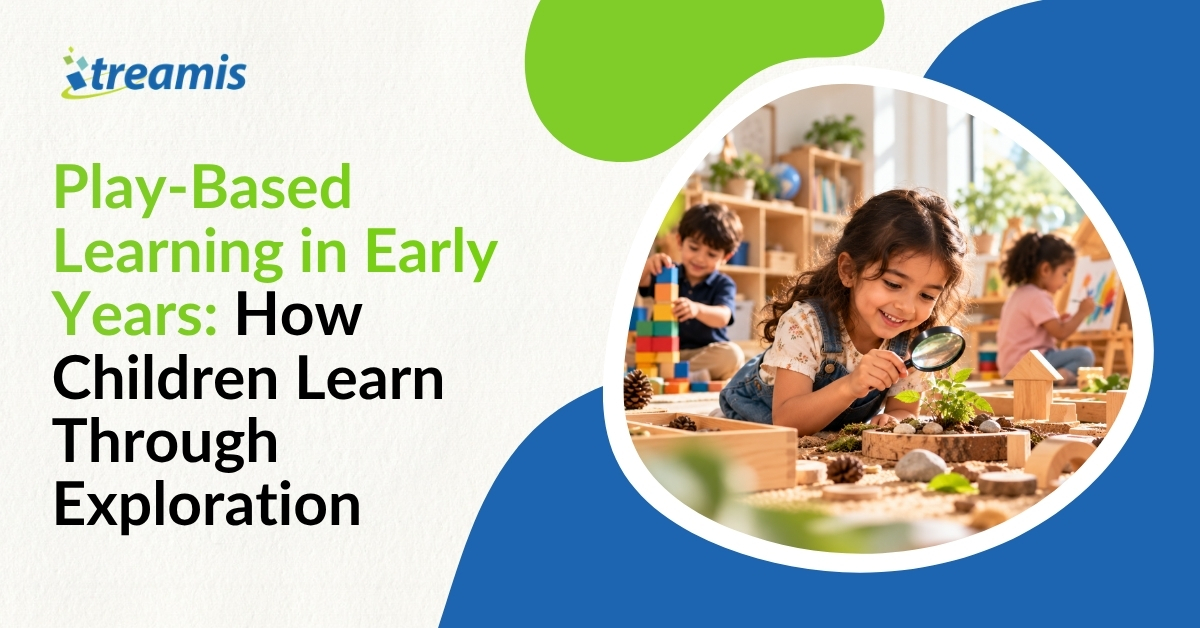
Hand a three-year-old an empty cardboard box and watch what happens. Within minutes, it becomes a boat, then a shop, then a cave. Nobody taught the child to do this, yet planning, language, negotiation, and imagination are all working. That small scene captures the idea behind play-based learning in the early years. Children build understanding by doing, testing, and wondering, not by sitting still and listening.
What Play-Based Learning in Early Years Really Means
Play-based learning isn’t just free time with a learning label. Instead of just teaching, educators set up environments, tools, and open-ended questions that let kids naturally stumble into concepts like numbers, cause and effect, and patterns through their own curiosity. The child chooses and explores. The adult observes, nudges, and extends.
This difference matters because play-based learning changes ordinary fun into intentional growth. For instance, a teacher notices a child lining up blocks by size, introduces the words “taller” and “shorter,” and asks, “What happens if we add one more?” The child stays in charge of the activity while the thinking deepens.
At Treamis, the Early Years programme runs from Pre-K to Upper K (ages 3 to 6) and is described as play-based and inquiry-led, with inspiration from Play-way and Montessori methodologies. The Starting Point Early Years section sets out how this sits within the IB Primary Years Programme.
Child Development Through Play: What Happens Beneath the Surface
Child development through play is easiest to understand when you look at it one piece at a time, and four key areas consistently stand out.
- Thinking: Balancing blocks or tracing how water moves through a funnel teaches children to predict, test, and revise. This is early problem-solving.
- Language: Pretend play pushes children to explain, ask, and narrate. As a result, vocabulary grows because we pick up new words naturally when we need them to make our point.
- Social and emotional growth: Sharing limited materials means taking turns, handling disappointment, and reading other people’s feelings.
- Physical skills: Climbing, pouring, threading, and drawing build the large and fine motor control that later supports writing.
One block-building session can touch all four areas. Therefore, splitting the day into “academic time” and “play time” misses how young children actually learn.
Play-Based Learning Benefits You Can Actually Observe
Parents often ask how to tell whether play-based learning in early years is working. Look for these signs:
- Your child asks more “why” and “what if” questions.
- They stay with a task longer, even when it gets difficult.
- They explain their ideas instead of only announcing answers.
- They recover from mistakes calmly because trying again feels normal.
- They cooperate in groups and negotiate roles.
These are the practical play-based learning benefits. Curiosity, self-belief, and the grit to keep trying are the real building blocks for every reading and math milestone down the road.
Five Kinds of Play and What Each One Builds
- Block and construction play: spatial reasoning, early geometry, persistence.
- Sensory play (sand, water, clay): observation, vocabulary, fine motor control.
- Pretend play: empathy, storytelling, understanding of social rules.
- Movement and music: coordination, rhythm, listening, emotional expression.
Treamis lists music and movement, sensory play, creative arts, block play, storytelling, and early science exploration among its Early Years activities.
The Adult’s Role in Play-Based Learning in Early Years
Good practitioners do three things: observe, ask open questions, and adjust the environment. Therefore, educators at Treamis encourage student agency, curiosity, and problem-solving.
The same habits work at home. Swap “What colour is that?” for “How did you make that?” or “What could we try next?” Also, when a child struggles, wait a moment before stepping in, because the struggle is often where the learning happens.
What a Strong Play-Based Curriculum Looks Like
A play-based curriculum should pass a simple visit test. Ask to see the classrooms and look for:
- Teachers who can explain what a child is learning from any given activity.
- Long stretches of uninterrupted play, not constant switching between tasks.
- Indoor and outdoor spaces designed for exploration.
- A clear path into primary school.
Easy Ways to Support Play-Based Learning in Early Years at Home
- Offer open-ended materials like boxes, cloth, spoons, and containers.
- Protect unhurried time daily. Boredom often comes just before invention.
- Follow your child’s lead and narrate what you see rather than directing.
Will Play Prepare My Child for Grade 1?
Children who grow up with play-based learning in early years arrive at formal learning with the habits it demands. At Treamis, Early Years sits inside the IB PYP, which runs from Pre-K through Grade 5, so the inquiry approach continues as children move up. Our PYP overview shows how.
Seeing It for Yourself
Reading about play-based learning in early years helps, but watching a classroom is better. Walk the campus, take the virtual campus tour, or enquire about admissions to ask your own questions.
FAQs
- What is play-based learning?
It is an approach where children explore materials, ideas, and roles through play while teachers set up the environment, observe, and ask guiding questions. The child leads; the adult extends the learning.
- At what age does play-based learning start?
It begins in the toddler years and continues through the early primary years. At Treamis, Early Years covers Pre-K (ages 3 to 4), Lower K (ages 4 to 5), and Upper K (ages 5 to 6).
- Is play the same as free time?
No. Free play is part of it, but a teacher plans the space and materials, watches what children do, and steps in with questions or new vocabulary at the right moment.
- Will my child learn to read, write, and count through play?
Yes. Block play builds early number and shape sense, storytelling builds vocabulary, and drawing and threading build the hand strength that writing needs. Formal skills grow from these foundations.
- How is learning through play different from a worksheet-based classroom?
Worksheets ask for one right answer. Play lets children try several routes, make mistakes safely, and explain their thinking, which builds problem-solving and persistence.