The International Baccalaureate Diploma Programme (IBDP) challenges students academically while developing skills beyond traditional classroom learning. Alongside six subject groups, the programme includes three core components: Theory of Knowledge (TOK), the Extended Essay (EE), and Creativity, Activity, Service (CAS).
For many students, IB CAS feels most different from traditional academic work. Instead of being centred on examinations, CAS asks students to learn through experiences, take initiative, work with others, and reflect on their development.
But what does IB CAS involve? What are the requirements, and how can students choose meaningful activities without turning CAS into another source of unnecessary stress? Let’s dive in!
What Is IB CAS?
IB CAS stands for Creativity, Activity, Service. It is one of the three elements of the IB Diploma Programme core and is undertaken alongside academic studies throughout the programme. CAS is not formally assessed through an examination. However, students must reflect on their experiences and provide evidence demonstrating achievement of the seven CAS learning outcomes.
The three strands have distinct purposes:
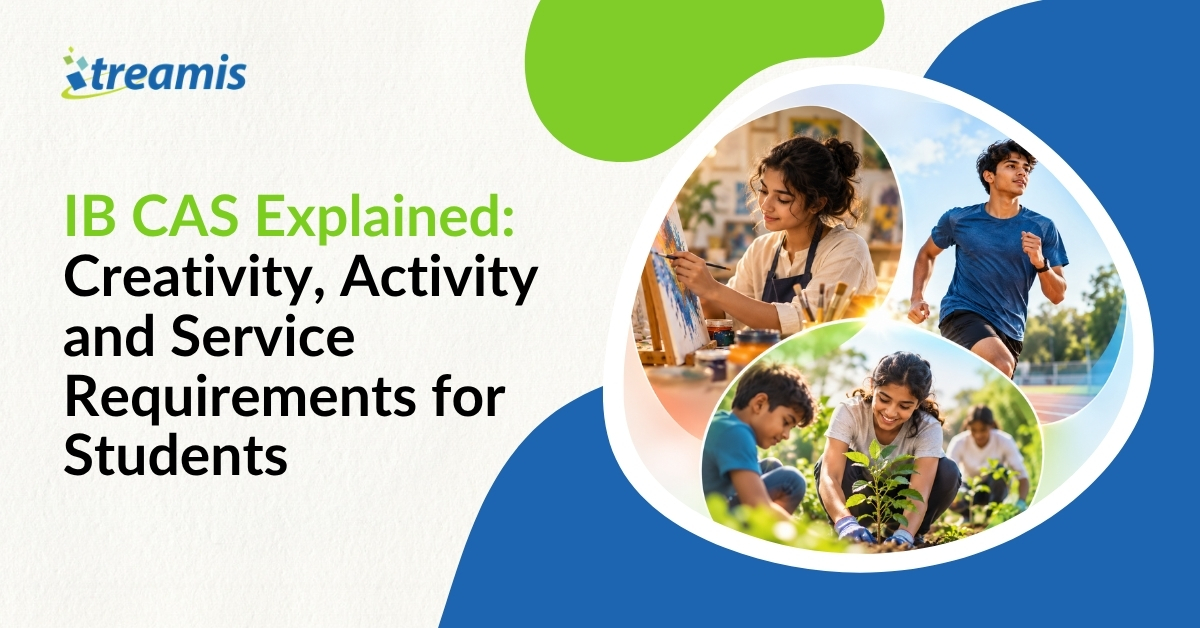
- Creativity: Experiences involving creative thinking, including the arts and other forms of creative work.
- Activity: Physical exertion that contributes to a healthy lifestyle.
- Service: Unpaid and voluntary engagement that provides a learning benefit while respecting the rights, dignity, and autonomy of those involved.
This makes IB Creativity Activity Service more than a collection of extracurricular activities. The focus is on what students experience, learn, contribute, and reflect upon.
How Does CAS Fit Into the IB Diploma?
The IB Diploma Programme is normally a two-year programme for students aged 16 to 19. Its core combines TOK, the Extended Essay and CAS with the six academic subjects.
The IB expects you to spread your CAS activities and projects across at least 18 months. This means leaving everything until the final few weeks won’t fly. A better strategy is to start early, identify interests, participate regularly, and reflect as experiences develop.
What Are the IB CAS Requirements?
Every IB school runs CAS differently, so students should follow their CAS coordinator and programme guidance. However, several fundamental expectations apply at the IB level.
Students participate in a range of CAS experiences and complete at least one CAS project. CAS experiences should involve meaningful activities, personal challenge, thoughtful planning and review, and reflection on outcomes and personal learning.
The IB also states that students must demonstrate achievement of seven CAS learning outcomes.
Importantly, the IB does not require a fixed number of hours in each strand for every student. The emphasis is instead on meaningful, sustained experiences and personal development.
Therefore, students should not select activities simply to accumulate hours. They should consider whether an experience provides genuine opportunities for learning, challenge, initiative, collaboration, or contribution.
Understanding the Three CAS Strands
- Creativity
Creativity includes arts and other experiences involving creative thinking. It could involve developing an artistic skill, producing something original, experimenting with a new creative form, or working collaboratively on a creative outcome.
Treamis highlights opportunities involving theatre, music, visual arts, and other creative experiences within its broader learning environment.
- Activity
Activity involves physical exertion that contributes to a healthy lifestyle. It does not have to mean competitive sport.
As the IB notes, an activity project can just be about challenging yourself physically, no competition required.
Therefore, Treamis provides sports facilities and opportunities, including soccer, basketball, cricket and swimming.
- Service
Service involves unpaid and voluntary engagement that benefits others while creating a learning opportunity for the student.
Treamis describes community service as an ongoing commitment to giving back to the community through student-led clubs involving areas like community service, arts, debate, and special interests.
What Is a CAS Project?
One of the most important CAS project requirements in the IB Diploma is completing at least one project. The project can focus on one CAS strand or combine two or all three.
For example, students might develop a creative production connected to a community issue, combine physical activity with fundraising for a community initiative, or work collaboratively on a sustained environmental project.
Practical CAS Project Ideas
Good CAS project ideas usually begin with something the student genuinely cares about. Possible directions include:
- Developing a theatre or creative performance project
- Learning and presenting a new artistic skill
- Organising a sustained physical activity challenge
- Creating a community-focused initiative
- Developing a recycling or environmental awareness activity
- Running a student-led club or collaborative project
- Combining creativity and service around a community need
That approach produces stronger reflections than simply recording what happened.
How Treamis Connects With CAS
At Treamis International School, the IB Diploma Programme centers on three core pillars: CAS, TOK, and the Extended Essay.
Students and parents can also explore our IB curriculum and IB school programme pages for information about the Diploma Programme, subjects and approach. We describe learning as extending beyond textbooks through activities, projects and experiences connected to real-life situations.
Final Takeaway
IB CAS complements the academic demands of the Diploma Programme through creativity, physical activity, service, collaboration, and reflection.
Students who start early, choose experiences connected to genuine interests, and reflect honestly will be in a much stronger position to demonstrate what they have learned from their CAS journey.
For families considering the programme, our campus facilities offer further information about spaces for sports, theatre, science, and learning.
FAQs
- Is CAS compulsory in the IB Diploma?
Yes. CAS is one of the three core elements of the IB Diploma Programme, alongside TOK and the Extended Essay.
- Is CAS graded?
CAS is not formally assessed through an examination. However, students must provide evidence of achieving the seven CAS learning outcomes through their experiences and reflections.
- How long does CAS last?
CAS runs regularly throughout the Diploma Programme, with IB guidance requiring CAS experiences and projects over at least 18 months.
- Do I need a fixed number of CAS hours?
Instead of prescribing a set number of CAS hours, the IB focuses on meaningful experiences, projects, learning outcomes, and sustained engagement, though individual schools may set their own requirements.
- What is the difference between a CAS experience and a CAS project?
A CAS experience can be an individual event or series of activities. A CAS project is a more sustained, purposeful project that requires planning, collaboration, and reflection. Students must complete at least one CAS project.