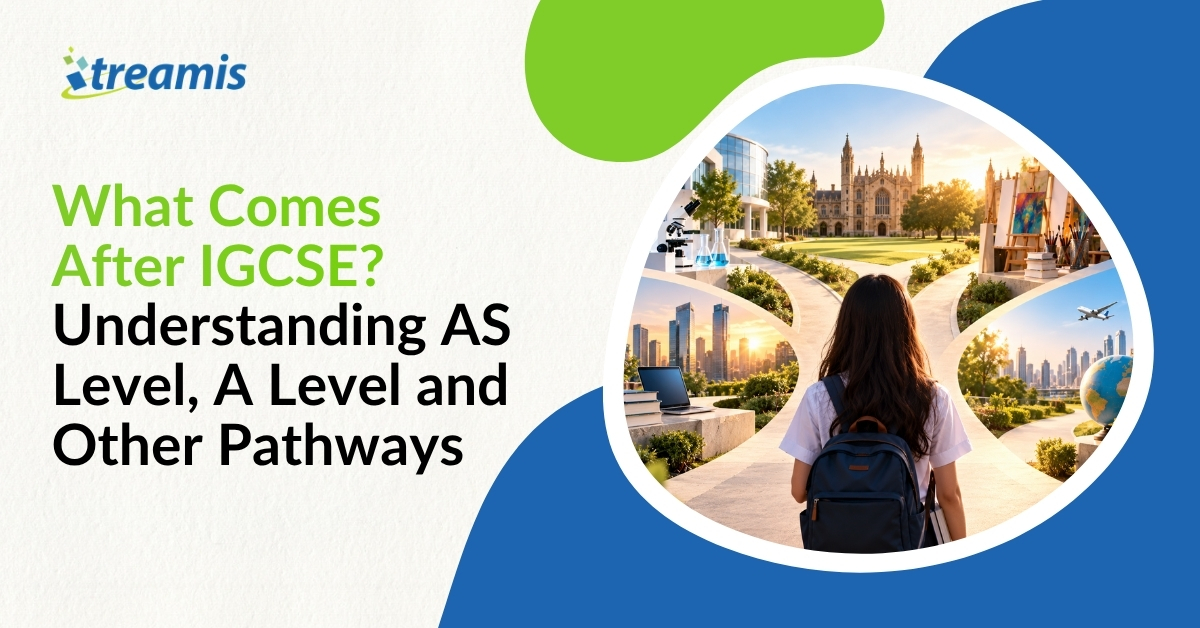
Results day feels like a weight lifting off your shoulders. But then comes the bigger question: what’s next after IGCSE? That answer shapes your next two years, the universities you can apply to, and the careers that stay open. In this guide, we explain the main routes, show how to match subjects to goals, and point out the mistakes students make at this crossroads.
Why This Decision Matters More Than It Looks
IGCSE is broad. Students clear at least five subjects drawn from languages, humanities, sciences, mathematics, and creative or professional options. However, Grade 11 does the opposite and narrows your focus. Instead of juggling many subjects, you study a few in depth. As a result, dropping a subject now locks you out of options down the road. For example, Engineering degrees usually expect Mathematics and Physics, and many medicine courses expect Biology and Chemistry.
Therefore, treating the “what after IGCSE” question as a degree-planning exercise is the single most useful mindset shift.
Four mistakes usually show up:
- choosing subjects because friends picked them,
- dropping Mathematics too early,
- overlooking degree prerequisites,
- and leaving the decision until results day.
Take your time with this in Grade 10 because hasty decisions here almost always backfire.
The Cambridge Pathway After IGCSE: AS and A Level
Anyone asking “what after IGCSE” within the Cambridge system usually lands here first. For most Cambridge students, the natural Cambridge pathway after IGCSE is AS and A Levels. Treamis describes the A Level as a two-year CAIE programme and some of the most in-depth preparation for university. It runs across Grades 11 and 12.
AS Level after IGCSE is the first stage of that journey. You study fewer subjects than IGCSE, yet still sample enough range to confirm your direction. A Level after IGCSE is where you complete the full course and build the depth that universities look for.
At Treamis, the A Level list includes Biology, Chemistry, Physics, Mathematics, Further Mathematics, Computer Science, Psychology, Accounting, Business, Economics, History, Sociology, English Language, Art & Design, and Global Perspectives & Research.
Note: AS and A Level subjects run subject to a minimum cohort of five students, so confirm availability early.
What to Study After IGCSE: Matching Subjects to Goals
Work backwards from where you want to end up, and the puzzle gets much clearer. These combinations draw on the subjects listed above:
| If you are drawn to… | Combinations worth considering |
| Medicine or biosciences | Biology, Chemistry, plus Mathematics or Physics |
| Engineering or physical sciences | Mathematics, Physics, Further Mathematics |
| Computing and data | Computer Science, Mathematics, Further Mathematics |
| Business, finance or economics | Economics, Business, Accounting, Mathematics |
| Psychology and social sciences | Psychology, Sociology, English Language |
| Design and creative fields | Art & Design alongside English Language or Business |
Three rules make what to study after IGCSE much easier to settle:
- Check degree requirements first. Open the course page of two or three target degrees and note the required subjects.
- Anchor your list in strength. Your IGCSE result in a subject is the best early signal of how you will cope with it at A Level.
- Keep one backup. If your interests shift, a flexible subject like Mathematics keeps more options alive.
What After IGCSE Besides A Levels? Other Pathways Worth Comparing
The IB Diploma is the main alternative. Treamis offers the IB Diploma Programme in Grades 11 and 12, and it suits students who are not ready to specialise because it keeps a wider spread of subjects. A Levels suit students who already know their strengths and want depth. Neither is “better”; they reward different learners.
Foundation and vocational programmes also exist, but check how well your target universities recognise them before committing.
IGCSE Career Pathways: From Subjects to Professions
Students asking “what after IGCSE” often worry that one choice will lock in a career. However, IGCSE career pathways are rarely a straight line. For example, a Biology student may end up in biotechnology, public health or data science; an Economics student might head toward finance, policy or entrepreneurship. What matters is choosing subjects that keep several routes open while you learn what you enjoy.
This is where guidance helps. At Treamis, career counselling is built around linking a student’s strengths to career goals, with academic advisers whose meetings become more frequent as grade levels rise. Universities from around the world also visit the school periodically, which lets students ask about courses directly.
A Five-Step Way to Decide What After IGCSE
- Write down three careers you could imagine.
- Look up the subject requirements for degrees leading to them.
- Shortlist four subjects, including one backup.
- Discuss your IGCSE strengths with a counsellor or subject teacher.
- Confirm the subjects are offered, then apply.
If you are weighing a move to a new school for Grade 11, the admissions page explains how to begin.
Final Thought
There’s no single roadmap after IGCSE. It really just comes down to what you’re good at and where you want to go. Therefore, start with the destination, choose subjects that serve it, and keep one eye on flexibility.
FAQs
- What is the most common route after IGCSE?
Most students move to AS and A Levels, the IB Diploma, or another Grade 11 and 12 programme. The right one depends on how specialised you want to be.
- Is AS Level compulsory after IGCSE?
No. AS Level is the first stage of the A Level route, so students who choose that route start with it, but other pathways exist.
- How many subjects should I take at A Level?
Most students take three or four, depending on the school’s structure and the degree they are aiming for. Check your target university’s requirements.
- Can I switch streams after IGCSE, for example from science to commerce?
Yes, but subject prerequisites matter. Moving from Business to Physics, for example, is harder without prior Physics study, so speak to an adviser first.
- Which A Level subjects are available at Treamis?
Biology, Chemistry, Physics, Mathematics, Further Mathematics, Computer Science, Psychology, Accounting, Business, Economics, History, Sociology, English Language, Art & Design, and Global Perspectives & Research.