
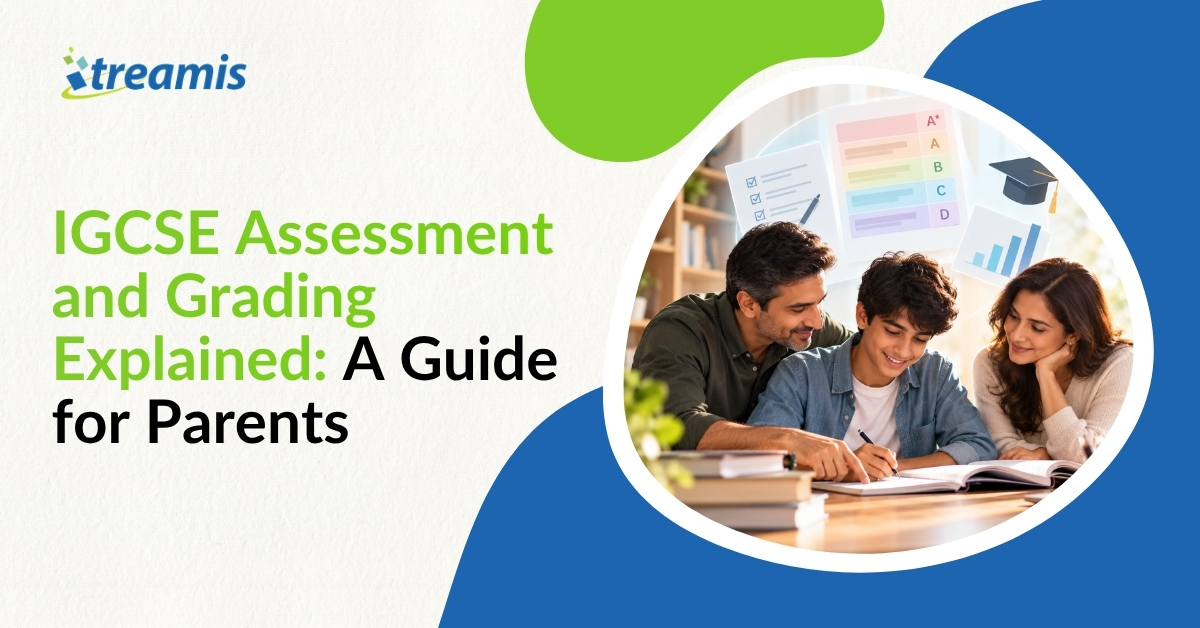
If your child has just started the Cambridge IGCSE programme, or you’re weighing it against other boards, the grading system can feel confusing at first. Report cards show letters instead of percentages, and the whole structure looks nothing like the marking systems most Indian parents grew up with. But don’t worry!
In this guide, we break down how the IGCSE grading system works, what each grade actually means, and how parents can use this information to support their child meaningfully.
What Makes Cambridge IGCSE Assessment Different
Unlike boards that rely almost entirely on a single year-end paper, the IGCSE assessment system combines written examinations with coursework, oral components, and practical assessments, depending on the subject. For example, a science subject typically includes a practical or alternative-to-practical paper alongside the theory papers. Languages often carry a listening or speaking component. This mix exists because Cambridge designs IGCSE to measure understanding and application, not just recall.
Also, your teachers grade your coursework first, and then Cambridge Assessment International Education (CAIE) moderates it externally. That external moderation keeps results consistent across schools and countries.
Therefore, a grade earned in Bangalore carries the same weight as one earned anywhere else in the world.
Cambridge IGCSE Grades: The A* to G Scale
Here’s where most of the confusion comes from. Cambridge IGCSE grades run on a nine-point scale from A* (the highest) down to G, rather than the percentage or CGPA format many Indian parents are used to. Unlike ICSE or CBSE reports, there’s no pass/fail cutoff. Instead, every grade from A* to G represents a recognized level of attainment, with G being the minimum reporting grade for a standard pass.
To put the IGCSE grading scale in simple terms:
- A* and A — Exceptional to strong command of the subject, including complex application and analysis
- B and C — Solid, consistent understanding with minor gaps
- D and E — Adequate grasp of core concepts, with room to strengthen application
- F and G — Basic familiarity with the subject, meeting minimum requirements
Teachers grade each subject independently. Thus, a report card might show an A* in Mathematics and a C in a second language. It reflects genuine strengths and areas needing more support.
How Grade Boundaries Actually Work
One detail that catches parents off guard is that the number of marks needed for an A* in one examination session isn’t fixed in stone every year. CAIE sets grade boundaries after each series based on overall paper difficulty.
Therefore, a 78% might be an A in one year and a B in a tougher year. It keeps standards comparable across sessions rather than penalizing a cohort because one year’s paper was harder. Parents sometimes assume a slipped boundary means a drop in ability, but it usually just reflects statistical standardization across the exam cycle.
The ICE Award: Going Beyond Individual Subject Grades
Students who clear a minimum of seven subjects, spread across the prescribed subject groups, become eligible for the International Certificate of Education (ICE) award, a recognition that sits above individual subject certificates. Within the ICE framework, outcomes fall into three bands: Distinction, Merit, and Pass, based on how many subjects a student clears at specific grade thresholds. It’s a useful way to evaluate a well-rounded academic profile.
What a Good IGCSE Grade Spread Actually Looks Like
Parents often ask what’s “normal.” The honest answer is that a healthy spread usually includes strength in the core subjects — English, Mathematics, and the sciences — alongside at least one or two subjects where a student shows genuine interest rather than just competence. Therefore, universities and AS & A Level pathways generally look for consistency in the core group more than a flawless report card.
How Parents Can Support Their Child Through IGCSE Assessment
A few practical habits help more than most parents expect:
- Read the subject-level feedback, not just the grade. CAIE reports often come with performance descriptors that point to specific weak areas.
- Track coursework deadlines separately from exam prep, since coursework quality directly affects the final subject grade in several subjects.
- Talk to subject teachers about grade-boundary context before reacting to a grade that seems lower than expected.
- Keep subject choice conversations going early, since IGCSE results shape eligibility for AS & A Level specializations later.
Treamis runs its Cambridge IGCSE programme across Grades 9 and 10 with this kind of ongoing feedback built into the structure, including Cambridge Checkpoint benchmarking before students even reach IGCSE. Parents considering the switch can review the full Cambridge and IGCSE curriculum structure or get in touch through the admissions page for subject-specific guidance.
FAQs
- What is the IGCSE grading system based on?
It’s based on a nine-point scale from A* to G, combining examination performance with coursework or practical components, depending on the subject.
- Is G a failing grade in IGCSE?
No. G is the lowest standard reporting grade and still counts as a recognized pass; there’s no separate fail category within the standard scale.
- How are Cambridge IGCSE grades different from CBSE marks?
CBSE reports percentages and CGPA, while IGCSE reports letter grades per subject, set against internationally moderated boundaries.
- Do grade boundaries change every year?
Yes. CAIE adjusts boundaries after each exam session based on overall paper difficulty, which keeps outcomes comparable across years.
- What subjects are compulsory for IGCSE?
Students typically register for English, Mathematics, and the sciences as core subjects, then choose additional subjects from the available groups.