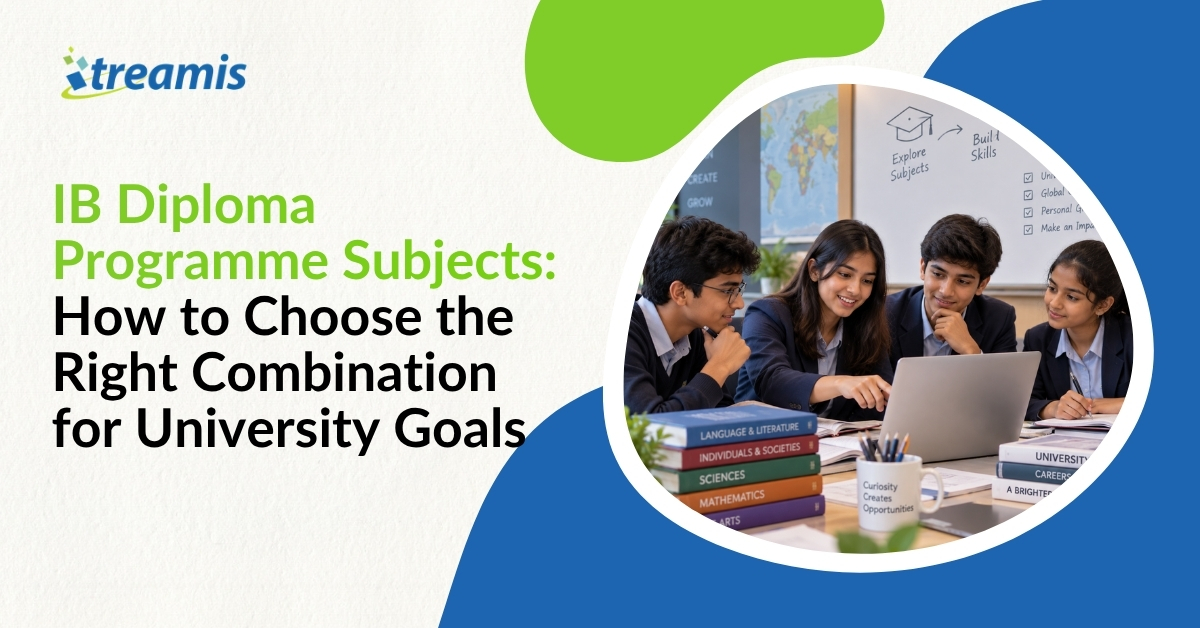
Choosing your IB subjects shapes the next few years of your journey. The combination a student chooses in Grade 11 often decides which university programmes stay open and which quietly close. Yet many families treat subject selection as a scheduling exercise.
In this guide, we break down how IB Diploma subject choices actually work, what universities look for, and a practical way to think through IB Diploma subjects before the final decision.
Understanding the IB Diploma Subject Groups
The International Baccalaureate Diploma Programme is built around six subject groups, plus three core elements: Theory of Knowledge, the Extended Essay, and Creativity, Activity, Service. Students typically pick one subject from each of the six groups, taking three (sometimes four) at Higher Level and the rest at Standard Level.
At Treamis, the IB Diploma Programme offers subjects across all six groups:
- Group 1: English Language and Literature
- Group 2: French, German, and Hindi
- Group 3: Economics, Business Management, Psychology, and Environmental Systems and Societies
- Group 4: Physics, Chemistry, Biology, Computer Science, and Sports, Exercise and Health Science
- Group 5: two Mathematics routes — Analysis and Approaches, and Applications and Interpretations — and
- Group 6: Visual Arts
Together, these choices make up your IB curriculum subjects. Understanding this structure is the real starting point for how to choose IB subjects that connect to a specific degree.
How to Choose IB Subjects With a University Goal in Mind
Most sixteen-year-olds don’t finalize a single career, and that’s normal. Therefore, what matters more is picking IB Diploma subjects that keep the right doors open.
Start from the degree, not the timetable. Look up two or three university courses a student is genuinely curious about and check their prerequisite subjects. For example, engineering programmes almost always expect Mathematics: Analysis and Approaches HL alongside Physics. Medicine and life-science degrees lean on Biology and Chemistry at HL. Economics or business degrees usually want Mathematics, often paired with Economics or Business Management HL.
Balance HL and SL by strength, not by ease. Higher Level subjects carry more depth and more weight for related degrees. But three HLs in subjects a student is genuinely strong in always beat three HLs because everyone else picked them. A mismatched HL choice usually shows up as a weaker grade, not a stronger application.
Keep Group 3 and Group 6 purposeful. Psychology, Economics, or Business Management support social science and commerce pathways. Similarly, Environmental Systems and Societies fits both Group 3 and Group 4, which suits students weighing sustainability-linked degrees. In addition, Visual Arts remains a genuine route into design and arts portfolios.
This is where dedicated career counseling and student counseling support can help you match subject strengths with a realistic degree.
IB Subjects for University: Matching Combinations to Common Pathways
Here’s how typical IB Diploma subject choices map onto popular university directions:
- Engineering & Computer Science: Mathematics AA HL, Physics HL, Computer Science HL/SL
- Medicine & Life Sciences: Biology HL, Chemistry HL, Mathematics AA or AI SL
- Business & Economics: Mathematics AA or AI SL/HL, Economics HL, Business Management HL/SL
- Psychology & Social Sciences: Psychology HL, Mathematics AI SL, Environmental Systems and Societies
- Design & Visual Arts: Visual Arts HL, English Language and Literature HL, a Group 3 elective
That said, admissions officers look at the whole picture. They take in your predicted grades, Extended Essay topic, and CAS involvement right alongside the classes you chose.
A Few Things Worth Avoiding
Choosing three HLs purely to look impressive on paper, ignoring a subject’s assessment style (coursework-heavy versus exam-based), or picking a language HL without real fluency are common regrets among IB Diploma students.
Subject selection works best as a conversation between interest, aptitude, and the target degree, not a race toward the hardest-sounding combination.
Why This Decision Deserves Real Support
Small class sizes and close mentor attention change how well this decision gets made. At Treamis, an overall teacher-student ratio of 1:8 and class sizes capped at 20 keep subject and university guidance personal. The results show in outcomes. Treamis alumni have gone on to universities and MNC internships worldwide, a track record visible on the college placement and beyond page.
Ultimately, choosing IB Diploma subjects is about matching today’s strengths to tomorrow’s goals. Families exploring this path further can connect with our admissions team to discuss subject planning in more detail.
FAQs
- How many IB Diploma subjects does a student need to choose?
Six — one from each subject group — plus the three core elements: Theory of Knowledge, the Extended Essay, and Creativity, Activity, Service.
- What’s the difference between HL and SL subjects?
Higher Level subjects involve more teaching hours and deeper content, typically three of the six. Standard Level subjects cover the same subject with less depth, usually the remaining three.
- Can a student change IB Diploma subjects after starting Grade 11?
Changes are possible early in the first term in most cases, but they get harder once coursework and internal assessments are underway, so the initial choice matters.
- Do all universities require specific IB subjects?
Many competitive programmes, especially engineering, medicine, and economics, list specific subject and HL/SL requirements, so checking target university pages directly is worthwhile before finalising choices.
- Is Higher Level Mathematics compulsory for engineering?
Most engineering programmes expect Mathematics: Analysis and Approaches at HL, since it builds the calculus and algebra foundation those degrees rely on.