A child’s first years are filled with moments that look ordinary to adults.
Stacking blocks. Asking “why?” again and again. Sharing a toy. Listening to a story. Trying to button a shirt. Waiting for a turn.
But these small moments are helping build the foundations for how a child thinks, communicates, manages emotions, solves problems, and learns.
That is why primary years education matters so much.
The early stage is not simply preparation for “real school.” It is real learning while children rapidly develop language, attention, confidence, relationships, and independence.
At Treamis International School, the Early Years journey combines purposeful play, inquiry, exploration, communication, social interaction, and age-appropriate independence. Here is why that approach matters.
The Early Years Build the Foundation for Future Learning
When we talk about early childhood development, we are talking about much more than whether a child can recognise letters or count to twenty.
Children are learning to focus, understand language, express emotions, build coordination, make choices, listen to others, remember instructions, and try again when something does not work.
Strong primary years education gives children repeated opportunities to practise these abilities in meaningful situations.
Learning is cumulative. Confidence in communication supports participation, simple routines build responsibility, and curiosity encourages deeper engagement with new ideas. Early learning becomes the platform on which later learning stands.
Early Learning Is More Than Reading and Numbers
Parents naturally want children to develop literacy and numeracy. Those skills matter.
But worksheets, handwriting, spelling, and counting are only part of the picture.
High-quality primary years education supports foundational learning skills through talking, listening, moving, creating, observing, sorting, comparing, pretending, experimenting, and collaborating.
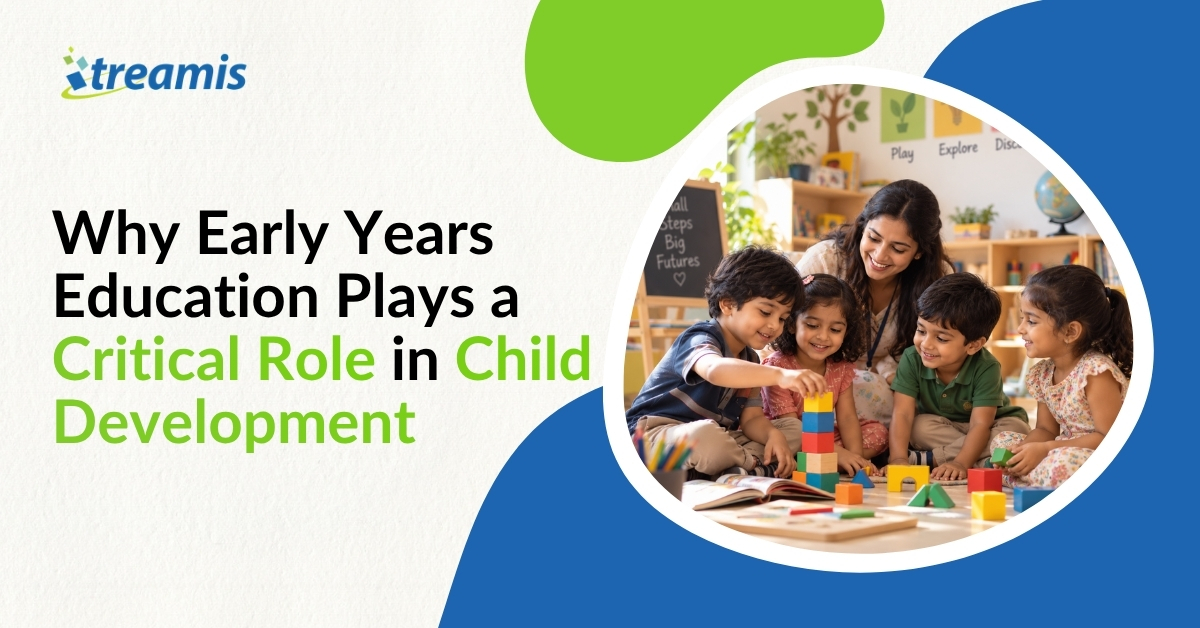
A child building a bridge with blocks may be estimating distance, testing balance, sharing materials, responding to failure, and changing the design. One activity can support language, motor skills, early mathematics, problem-solving, and persistence.
That is one reason the preschool education benefits of purposeful play extend far beyond keeping children busy.
Why Is Play So Important in the Early Years?
Young children learn by doing.
They touch, move, imitate, repeat, test, imagine, and ask questions. That makes play one of the most natural ways to support cognitive development in children.
At Treamis, the Starting Point Early Years programme includes music and movement, sensory play, creative arts, block play, storytelling, early science exploration, physical activity, and life-skill experiences.
A pretend shop can introduce numbers, vocabulary, cooperation, and decision-making, while a story can develop listening and imagination. Effective early-years classrooms design play so that learning happens naturally.
Curiosity Develops Thinking Skills
Watch how young children investigate something unfamiliar.
They rarely begin with a definition. They look, touch, ask questions, guess what might happen, test an idea, and try again.
That is inquiry.
Thoughtful primary years education protects this instinct instead of replacing it with constant instructions.
At Treamis, learners are encouraged to explore, inquire, make connections, and apply their understanding to real-life situations. Educators guide thinking and support discovery rather than simply providing every answer.
This helps strengthen foundational learning skills such as observation, reasoning, communication, and problem-solving.
More importantly, it tells a child:
Your questions matter.
Social and Emotional Skills Are Learned Through Experience
A four-year-old does not automatically know how to enter a group, negotiate over a toy, wait patiently, understand another child’s feelings, or recover from disagreement.
These skills are learned.
That is why social and emotional learning is an important part of early education.
Children share materials, work in pairs, listen to different ideas, ask for help, solve small conflicts, and celebrate each other’s achievements.
Good primary years education gives teachers opportunities to guide children through these everyday moments rather than treating them as interruptions to academic learning.
Over time, children develop empathy, confidence, cooperation, and self-control—abilities that also support concentration and classroom participation.
Independence Starts With Small Responsibilities
Independence does not mean expecting young children to do everything alone.
It grows gradually.
It can begin with putting away materials, choosing an activity, carrying a school bag, following a classroom routine, attempting a task before asking for help, or explaining what to do next.
This is where primary years education can make a lasting difference.
Treamis’s Early Years progression encourages children to build independence and self-management in age-appropriate ways, with older kindergarten learners taking greater ownership of their learning.
These small responsibilities build confidence.
A child begins to think, “I can try this.”
That belief is one of the most valuable preschool education benefits because capable learners are often more willing to attempt unfamiliar tasks.
Language, Movement, and Thinking Develop Together
Children develop language by hearing rich speech, participating in conversations, listening to stories, singing, role-playing, asking questions, and explaining their ideas.
Quality primary years education creates many opportunities for this communication.
Storytelling builds vocabulary, group discussions teach children to listen and respond, and dramatic play gives language a real context.
Movement matters too. Fine-motor skills support tasks such as writing, while gross-motor development builds balance and coordination. At Treamis, physical education, swimming, music and movement, arts, and outdoor experiences complement classroom learning.
This whole-child approach supports cognitive development in children because physical, social, language, and thinking skills influence one another.
Mistakes Can Build Resilience
Imagine a classroom where children are afraid to give the wrong answer. They quickly learn to stay quiet.
Now imagine a teacher asking, “What made you think that?”
The second classroom turns mistakes into opportunities.
High-quality primary years education gives young learners space to experiment, reconsider, and try again.
When an idea fails, children can adjust their strategy. With supportive guidance, failure becomes part of discovery. This strengthens foundational learning skills such as persistence, flexibility, and problem-solving.
Why Social and Emotional Learning Matters for School Readiness
Academic ability alone does not guarantee that a child will thrive.
Children also need to understand themselves and interact constructively with others.
Through social and emotional learning, young children begin recognising emotions, communicating needs, building friendships, taking responsibility, showing empathy, and managing age-appropriate frustration.
For parents researching primary years education, it is worth looking beyond the academic timetable. Ask how a school develops confidence, relationships, independence, communication, and emotional well-being.
These abilities can make the transition into more structured primary grades much smoother.
Age-Appropriate Learning Matters
More content does not automatically mean better education.
Giving a five-year-old work designed for an older child may appear academically ambitious, but developmentally appropriate learning is more valuable.
Treamis states that its curriculum is designed around the developmental needs of learners, with preschool focusing on cognitive and motor skills before children progress towards broader transdisciplinary learning.
Good primary years education challenges children without overwhelming them.
The goal is progress, not pressure.
Children should experience learning that stretches their thinking while still leaving room for curiosity, success, movement, and joy.
Why a Strong Start Influences Later Learning
The habits children develop early can remain valuable for years.
A child who learns to ask questions may become a more active researcher. A child who practises sharing ideas can become a confident communicator, while independence can make future responsibilities easier to manage.
That is why early childhood development cannot be treated as a phase that matters only until Grade 1.
Parents interested in how early foundations connect to longer-term pathways can also explore Treamis’s discussion of foundational learning skills within internationally benchmarked curricula.
The stronger the foundation, the more confidently children can build on it.
What Does Early Years Education Look Like at Treamis?
Treamis International School’s Starting Point programme supports learners from Pre-Kindergarten through Upper Kindergarten in a safe and stimulating environment.
Its approach draws on the IB Primary Years framework along with Play-way and Montessori influences. Children learn through purposeful play, hands-on exploration, inquiry, communication, creative expression, movement, and collaboration.
The programme supports early childhood development across social, emotional, physical, language, and cognitive areas. As children progress, they build literacy, numeracy, STEM awareness, communication, independence, inquiry skills, and readiness for Grade 1.
That is what effective primary years education should do: prepare a child for the next stage without turning childhood into a race towards the next academic milestone.
What Should Parents Look for in an Early Years Programme?
Look beyond a beautiful classroom.
Do children have opportunities to speak, move, build, create, question, collaborate, and make choices? Ask how teachers respond to mistakes and support different developmental needs. Look for strong relationships between educators and children, and notice whether learning feels joyful.
The real preschool education benefits appear when children feel safe enough to participate, curious enough to explore, and confident enough to try.
Final Thoughts
The early years pass quickly, but their influence can last much longer.
Children are developing far more than academic knowledge. They are learning to communicate, regulate emotions, solve problems, make decisions, and see themselves as learners.
That is why primary years education deserves careful attention.
When schools combine purposeful play, inquiry, nurturing relationships, age-appropriate challenge, physical activity, social interaction, and opportunities for independence, they create conditions in which children can grow across multiple dimensions.
At Treamis, the Early Years approach reflects that whole-child understanding.
Because the goal is not simply to make a child ready for Grade 1.
It is to give that child the confidence, curiosity, skills, and love of learning needed for everything that comes after it.
FAQs
- Why is primary years education important?
It builds strong foundations for learning, communication, confidence, problem-solving, and overall child development. - What skills do children develop during the early years?
Children develop language, motor, cognitive, social, emotional, and foundational learning skills. - How does play support early childhood development?
Play helps children explore ideas, solve problems, communicate, collaborate, and learn through real-life experiences. - What are the main preschool education benefits?
Preschool supports school readiness, independence, curiosity, social skills, emotional development, and early literacy and numeracy.